
The Real Adoption Curve: India's Fight for Trust in a Fake-Flooded Market
- BioPrime Stories & latest news

- The Real Adoption Curve: India's Fight for Trust in a Fake-Flooded Market
The Real Adoption Curve: India's Fight for Trust in a Fake-Flooded Market
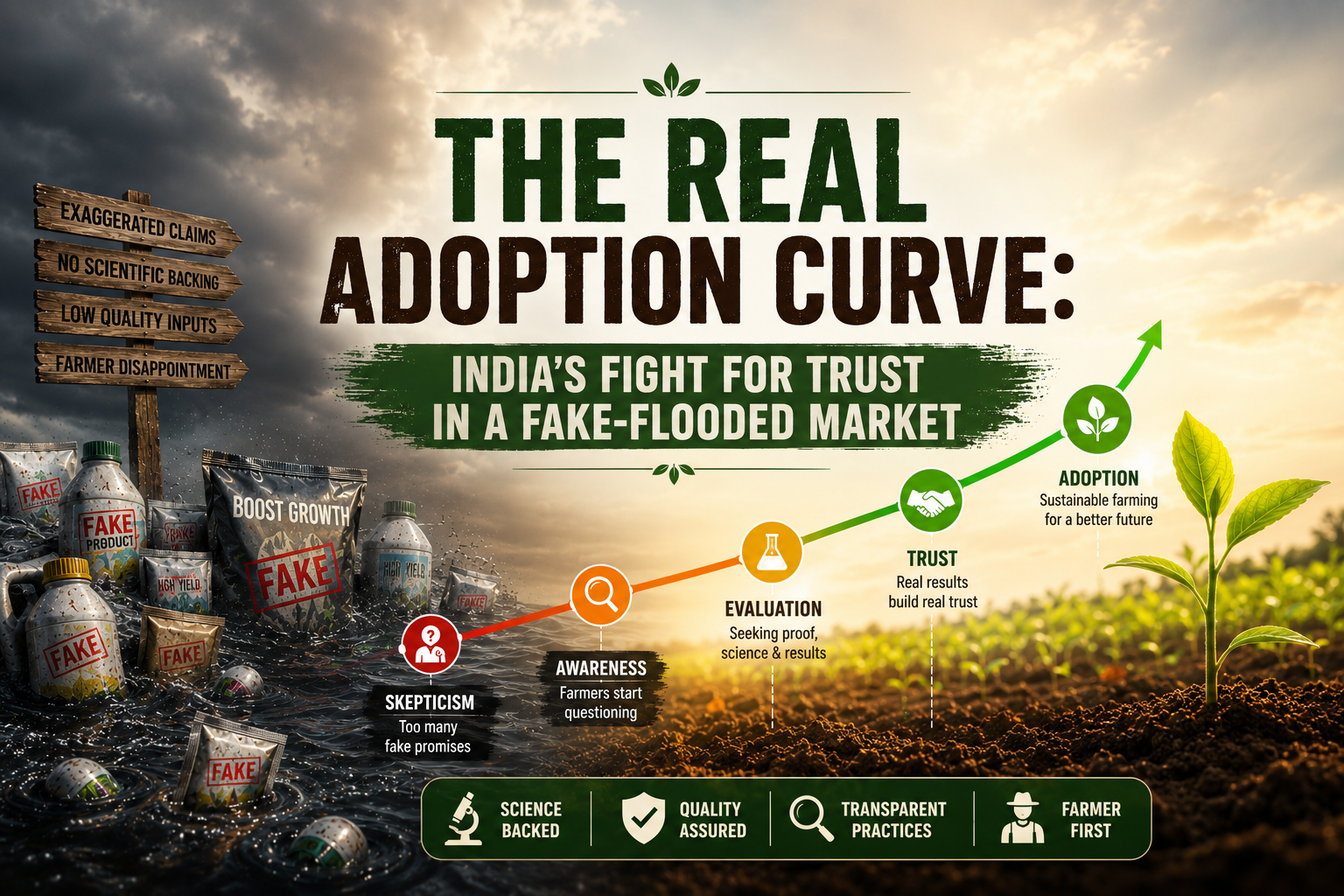
WHY INDIAN FARMERS ADOPT BIOLOGICALS DIFFERENTLY
It isn't acreage or corn and soy that drives adoption here — it's trust, economics, and a market still fighting off its own counterfeits
Ask most global agri-input executives what drives biologicals adoption, and the answer comes back the same way: acreage. Big, mechanized, monocropped acreage — the kind that lets a single inoculant decision scale across 13 million hectares of Mato Grosso soybean, or get bundled into a seed-treatment line running through Iowa corn country. It's a clean story: large farms, uniform crops, agronomist-advised, data-driven, fast to adopt once the ROI is proven.
India doesn't have that story. And trying to force it onto Indian adoption patterns is exactly why so many biologicals strategies built for the US or Brazil underperform here. India's path to scale runs through 86% small and marginal farms, a dozen major cropping systems, a trust network built on neighbors rather than agronomists, and a counterfeit market so large it actively damages the category's credibility. Understanding that shape isn't optional — it's the entire strategy.
The Scale Myth: Why India Doesn't Adopt Like the US or Brazil
Start with the raw market numbers, because they tell an honest story before any narrative gets layered on top.
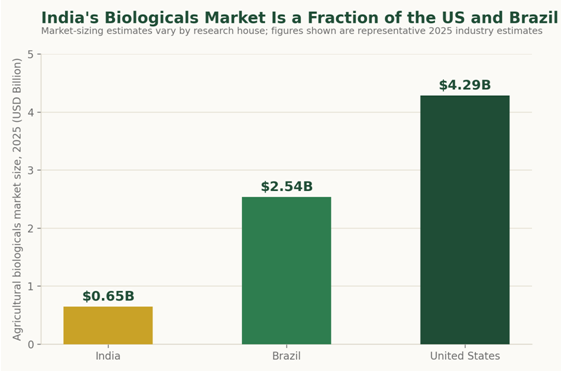
Figure 1: Representative 2025 market-size estimates for agricultural biologicals, India vs. Brazil vs. the United States.
The US agricultural biologicals market is valued at roughly $4.29 billion in 2025, propelled by expanding acreage in wheat, soybeans, and cotton. Brazil sits at roughly $2.5 billion, concentrated overwhelmingly in soybean and corn across the Center-West's mechanized mega-farms. India, by contrast, is estimated at somewhere between $650 million and $1 billion depending on the research house — a fraction of the other two, despite having by far the largest number of farmers in the world.
That gap isn't really about awareness or willingness. It's structural. Now look at adoption rate rather than market value — a very different, and more revealing, cut of the same story:
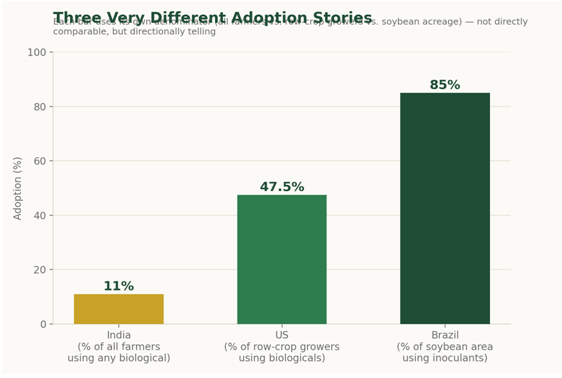
Figure 2: Adoption comparison across India, the US, and Brazil. Note the differing denominators — these are illustrative of scale, not a like-for-like ratio.
In Brazil, 85% of soybean acreage was inoculated with Bradyrhizobium in the 2022/23 season — a technology so embedded that Embrapa, cooperatives, and seed-treatment equipment have made it close to a default agronomic step, not an optional add-on. In the US, industry surveys put 45–50% of row-crop growers (corn, soy, wheat) as active biologicals users, with a striking 42% having run their own on-farm trials before adopting — a data-driven, farmer-as-scientist culture that mechanized scale makes possible.
India's overall adoption sits at just 11% of farmers as of 2024 — up from 7% in 2022, a real 1.5x jump, but still an order of magnitude behind the US and Brazil on a like-for-like basis. The reason isn't that Indian farmers are more conservative or less rational. It's that the entire adoption engine — farm size, crop diversity, advisory access, capital availability — is built completely differently.
Three structural differences explain most of the gap:
- No single-crop leverage point. Brazil's story is basically one crop (soybean) on one kind of farm (large, mechanized). India has rice, wheat, cotton, sugarcane, pulses, and a vast horticulture sector, each with different soils, pests, and economics — there is no single inoculant decision that scales the way Bradyrhizobium does across Mato Grosso.
- No agronomist-per-farm model. A US or Brazilian grower often works with a paid agronomist or cooperative advisor who can validate a new input on-farm. Indian smallholders, farming a hectare or two, cannot economically support that relationship — so trust has to travel through cheaper channels: the dealer, the neighbor, the demonstration plot.
- Different risk economics. A Brazilian soy farmer risking part of a 300-hectare block on a new biological can absorb a bad batch. An Indian smallholder risking a third of a 1-hectare plot on an unfamiliar product is risking a much larger share of total household income — which makes trust and proof-before-purchase far more important than price alone.
What Indian Farmers Actually Use, By Crop
Despite the diversity of Indian cropping systems, the data shows a surprisingly concentrated pattern of use:
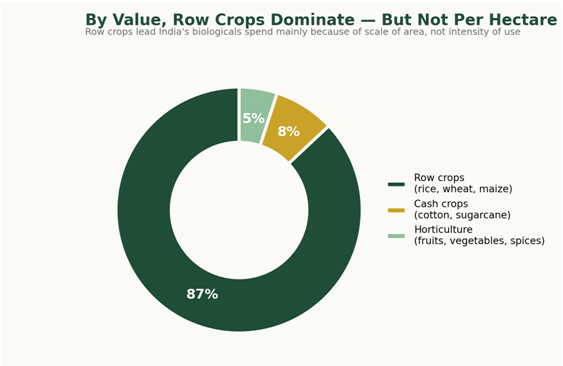
Figure 3: Share of India's agricultural biologicals market value by crop category.
Row crops — rice, wheat, and maize — account for roughly 87–88% of India's biofertilizer and biopesticide market by value. That number surprises people who assume biologicals in India must be a horticulture story, given the export premiums attached to grapes, mangoes, and spices. The real explanation is simpler: cereals occupy roughly 60% of India's cultivated land, so even modest per-hectare spending on biologicals compounds into the largest absolute market by sheer scale of area.
Cash crops — cotton and sugarcane — follow, leveraging both government minimum-support-price stability (which frees up cash for input experimentation) and export-linked organic certification. Horticulture is smaller in total value today, but it's the highest-intensity segment per hectare: protected cultivation acreage (greenhouses, shade-net farming) is growing at roughly 15% a year, and liquid, fertigation-compatible biologicals there carry 40–60% price premiums over standard carrier-based products, because grape, mango, and vegetable exporters are chasing residue-free compliance that pays for itself in market access.
The insight worth sitting with: India's biologicals market is being built on row-crop scale, but it's being proven on horticultural intensity. The high-value, export-linked crops are where science-backed products get their first real field validation and premium pricing — before those learnings cascade down into cereals and cash crops.
Why They Buy What They Buy
When Indian farmers who have adopted biologicals are asked why, the answers are unambiguously economic — not ideological:
|
Reason cited for adoption |
Share of adopting farmers |
|---|---|
|
Lower cost per acre |
74% |
|
Better crop protection from insects |
74% |
|
Better overall product efficacy |
55% |
|
Government subsidy was the major driver (among sustainable-practice adopters) |
54% |
This lines up with the harder cost data. Urea prices oscillated between roughly ₹266 and ₹310 per kilogram through 2024, while a standard biofertilizer regimen costs only ₹150–200 per hectare. Freight surcharges push landed synthetic-fertilizer costs up another 8–12% in remote areas — a mark-up that locally produced biologicals largely bypass. During periods of price volatility, farmers can secure payback on biological substitution within two seasons for pulses, sugarcane, and cotton.
Layered on top of the input-cost math are two additional forces unique to specific crop segments: export-oriented growers (basmati rice, grapes, spices, tea) adopt biologicals to meet tightening residue limits in international markets, and government schemes — the National Mission for Sustainable Agriculture, Paramparagat Krishi Vikas Yojana, PM-PRANAM, and the National Mission on Natural Farming (₹2,481 crore budget) — directly subsidize the switch for a meaningful share of first-time adopters.
In short: Indian farmers don't adopt biologicals because they've been persuaded biologicals are inherently better. They adopt when the cost math, the export premium, or the subsidy makes the decision economically obvious — and efficacy has to hold up fast enough to keep them buying next season.
Who Actually Influences the Purchase
This is where India's adoption engine looks most different from the West — and it's arguably the single most important operating fact for anyone selling biologicals here.
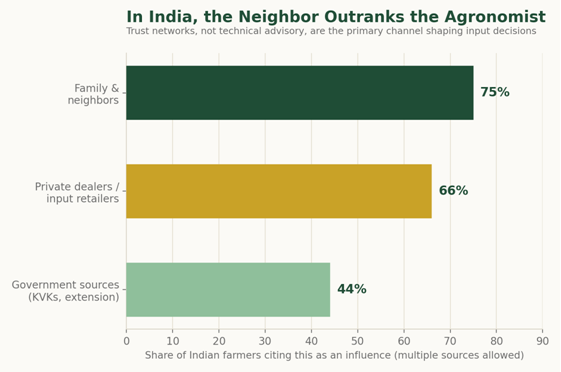
Figure 4: Share of Indian farmers citing each source as an influence on farming and input decisions (farmers could cite multiple sources).
Seventy-five percent of Indian farmers say they're likely to take advice from family and neighbors on matters like soil health — compared with just 24–35% of farmers surveyed in other countries. In Latin America, by contrast, the top influence is a paid agronomist; Brazilian adoption in particular is deeply tied to that professional-advisory relationship. India simply doesn't have that density of paid agronomic advisory reaching smallholders, so the trust vacuum gets filled by the person next door who tried something last season.
Private input dealers remain the next most important channel — roughly 66% of farmers approach private dealers for input decisions, compared with 44% who rely on government extension sources like Krishi Vigyan Kendras (KVKs). Dealers combine product access, informal credit, and (inconsistent) technical guidance in a single relationship — which is exactly why counterfeit products entering through that same channel are so damaging (more on that below).
The strategic implication is blunt: in India, winning the demonstration plot in one village is worth more than any advertising spend, because the neighbor-to-neighbor trust network does the distribution work that a paid agronomist does in Brazil or a data-sharing culture does in the US. KVKs run exactly this kind of demonstration model, but by the industry's own account, they currently reach “only a small fraction of agricultural villages.” That gap — not product efficacy — is often the real adoption bottleneck.
The Elephant in the Warehouse: India's Unorganized Biologicals Market
Here is the roadblock that doesn't show up in most market-sizing reports, but shapes farmer behavior more than almost anything else.
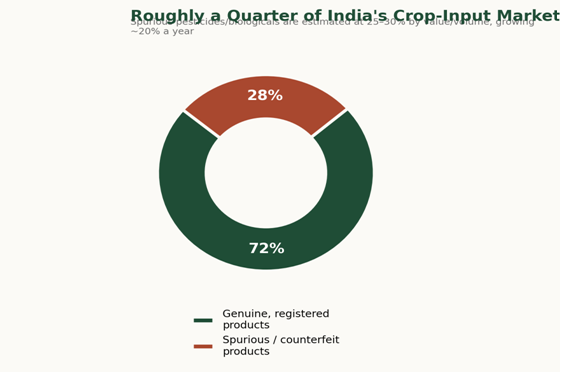
Figure 5: Estimated share of India's crop-protection market that is spurious or counterfeit, by value/volume.
Independent studies — including work cited by FICCI and CropLife International — put spurious or counterfeit products at 25–30% of India's pesticide market by value and volume, a problem growing at roughly 20% a year. The Directorate of Plant Protection, Quarantine and Storage estimates non-genuine products cause 10.6 million tonnes of lost food production annually. In one widely cited 2017 case, spurious pesticides destroyed roughly 60% of Punjab's cotton crop in the worst-affected districts.
Biologicals are, if anything, more vulnerable to this problem than synthetic chemicals — not less. A counterfeit chemical pesticide at least contains some active ingredient, however diluted; a fake microbial biofertilizer or biopesticide can be nothing more than water, talc, or an inert carrier with zero viable colony-forming units. Visually, on a dealer's shelf, it is indistinguishable from the genuine product. The farmer only discovers the difference in the field — and by then the damage is done.
This creates a uniquely corrosive trust problem for the entire category. Biologicals already ask farmers for patience: field trial data shows season-long control comparable to chemicals, but the visible knock-down is slower, and a meaningful share of first-time users discontinue after a single underwhelming cycle. Layer a 25–30% chance that the product itself was fake onto that already-fragile first impression, and one bad batch doesn't just cost one farmer one season — it can quietly convince an entire village that “biologicals don't work,” undoing years of legitimate field demonstration in a single crop cycle.
This is why the unorganized market isn't a side issue for India's biologicals sector — it is arguably the single biggest structural roadblock to scaling genuine, science-backed products, more so than price, awareness, or even regulation.
What Needle Must Move for India to Reach 30–40% Adoption
Getting from today's ~11% to a mature 30–40% adoption rate — roughly where the US row-crop segment sits today — is not simply a matter of waiting for the current growth curve to continue. It requires deliberate movement on five specific levers:
- Quality traceability at the point of sale. Batch-level verification (QR codes, SMS-based authentication, CIB&RC registration lookups accessible to dealers and farmers) needs to become as routine as checking an expiry date — closing the exact gap counterfeiters currently exploit.
- Dealer accountability and training at scale. Efforts like the 200,000-dealer awareness campaign run by CropLife India and the government are a start, but with hundreds of thousands of retail points nationally, this needs to be a default part of every distributor's onboarding, not a periodic campaign.
- Multiplying the demonstration-plot engine. Given that 75% of farmers trust neighbors over any other source, the single highest-leverage investment is expanding KVK-style village demonstrations far beyond their current “small fraction of villages” reach — because every successful demo plot is, functionally, dozens of future customers.
- Communicating the payback, not just the science. Adoption data shows farmers respond to cost-per-acre and efficacy claims, not sustainability framing. The two-season payback against volatile urea and DAP pricing is a stronger, more replicable sales argument than any environmental message.
- Faster, more consistent registration. BioRRAP has already shortened registration timelines meaningfully; extending that consistency across every state — several still lack their own specific implementation guidelines despite central policy — would let credible new products reach farmers faster than counterfeits can undercut them.
None of these are exotic interventions. They are distribution, trust, and enforcement problems — which is, in a way, good news: they are solvable with the same discipline India has already applied to organized retail, digital payments, and formal credit in rural markets over the last decade.
What the Future of Biologicals in India Actually Looks Like
Every major market-research estimate — despite disagreeing on the exact base number — agrees on direction: India's agricultural biologicals market is on track to roughly double or triple by the early 2030s, growing at a consistent 11–14% CAGR across nearly every published forecast. That growth is close to inevitable given input-cost pressure, export residue requirements, and government policy tailwinds. The more interesting question isn't whether the market grows — it's what kind of adoption gets built underneath that growth number.
A few things seem clear from the data already in front of us:
- The winners won't just be product manufacturers. Industry analysis increasingly points to “integrated solution providers” — companies combining biological products with agronomic advisory, digital extension, and performance monitoring — as the more durable business model, precisely because product quality alone can't overcome India's trust and distribution gap.
- Consolidation is coming, slowly. Today's market is extremely fragmented — the top five biopesticide players hold less than 10% combined share. As quality enforcement and traceability improve, that fragmentation should compress, squeezing out the unorganized segment the way organized retail gradually did to informal rural trade.
- Horticulture and export crops will keep leading, not following. The highest-value validation of new biological science will keep happening on grapes, mangoes, spices, and basmati rice first, where residue compliance pays a real premium — and those product learnings will cascade down into mainstream cereal and cash-crop use over time.
- Scale will look like village trust networks, not tractor-mounted precision. India's version of Brazil's 85%-inoculated soybean belt will never be a single mechanized decision replicated across millions of uniform hectares. It will be a biological product working well enough on one farmer's plot that the neighbor buys it next season — repeated, one demonstration and one dealer counter at a time, across hundreds of thousands of villages.
Building for the Market India Actually Has
The temptation, looking at Brazil's 85% soybean inoculation rate or the US's data-driven row-crop adoption, is to ask when India will "catch up." That's the wrong question. India was never going to adopt biologicals the way a 300-hectare mechanized soy farm does, because India isn't that farm. It's 146 million small holdings, a dozen major crops, a trust economy built on neighbors and dealers rather than paid agronomists, and a counterfeit market actively working against the category's credibility.
At Bio Prime, this is the market we build for — science validated against India's actual soils and cropping systems, distributed through the relationships Indian farmers already trust, and priced against the economics that actually move a purchase decision. Reaching 30–40% adoption in India will not look like Brazil's story rerun at a different scale. It will be a distinctly Indian story — built village by village, season by season, on proof a farmer can see in their own field.