
HOW MUCH TIME DOES INDIAN SOIL HAVE LEFT?
- BioPrime Stories & latest news

- HOW MUCH TIME DOES INDIAN SOIL HAVE LEFT?
HOW MUCH TIME DOES INDIAN SOIL HAVE LEFT?
What the data says about the state of our soil, the clock we're on, and what it will actually take to rebuild it
Every conversation about Indian agriculture eventually circles back to yield, price, or subsidy. Soil rarely gets top billing — it's the thing crops grow in, not the thing anyone measures. But soil is not a stable backdrop. It is a living, finite resource, and by every national dataset available, it is degrading faster than it is being rebuilt.
This isn't a future risk. It's a measured, ongoing trend — and the data tells us three things clearly: how bad it already is, how fast it's moving, and how large a response it will take to actually turn around.
Insight 1: The Soil Has Already Lost Most of Its Living Carbon
Soil Organic Carbon (SOC) is the single best proxy for soil health — it drives water retention, structure, and the microbial life that makes nutrients available to roots. In the 1950s, Indian soils carried roughly 1% SOC on average. Today, across most agricultural regions, that figure sits between 0.3% and 0.4% — well below the 1–1.5% threshold agronomists consider the minimum for healthy, resilient soil.
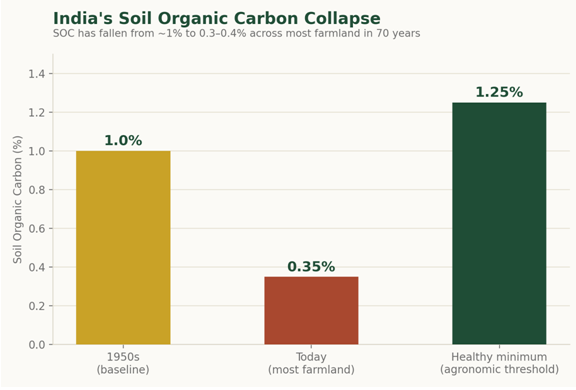
Figure 1: India's soil organic carbon, then vs. now vs. the healthy minimum threshold.
This is not a historical footnote. A 2017–2023 ICAR-coordinated study analyzing 254,236 soil samples across 620 districts confirmed that organic carbon is still actively declining in large parts of the country today — driven by intensive cultivation, skewed fertilizer use, and a near-total absence of organic replenishment (compost, green manure, crop residue) at scale.
Insight 2: Degradation Isn't Stabilizing — It's Accelerating
ISRO's Space Applications Centre has tracked land degradation across India through three national assessments since the early 2000s. Each one shows the same direction of travel:
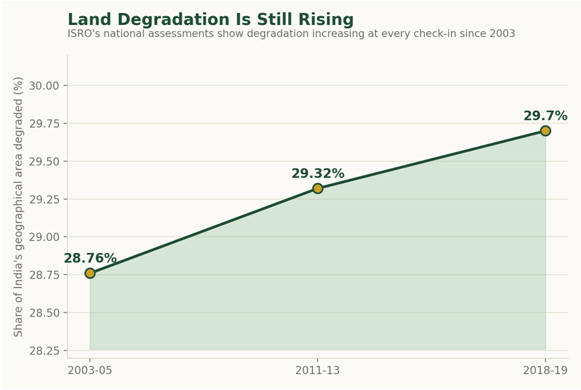
Figure 2: Share of India's total geographical area under land degradation, across three national assessments.
By 2018–19, 97.85 million hectares — 29.7% of India's entire geographical area — was degraded, up from 28.76% in 2003–05. Desertification specifically increased across 28 of India's 31 states and union territories between 2011–13 and 2018–19. Whatever interventions have been tried at a national scale over the last two decades, they have not been enough to bend this curve — only to slow parts of it in a handful of states.
Insight 3: We're Feeding the Symptom, Not the Soil
A large part of why organic carbon and soil structure keep declining traces back to one number: the ratio in which India applies its three primary nutrients. The agronomically recommended balance is 4 parts Nitrogen to 2 parts Phosphorus to 1 part Potassium (4:2:1). India has never consistently hit that ratio — and the gap has widened, not narrowed, over the last three decades.
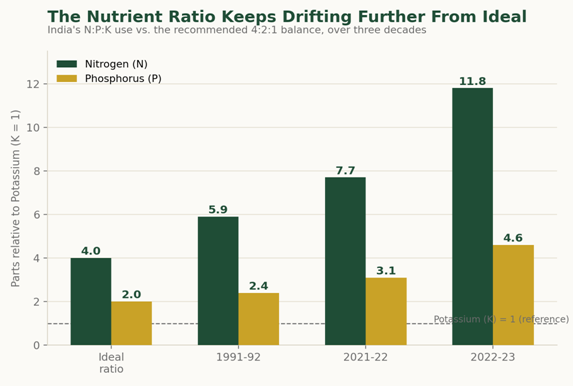
Figure 3: India's actual N:P:K use relative to the recommended 4:2:1 balance, 1991-92 to 2022-23.
Cheap, heavily subsidized urea has pulled nitrogen use far ahead of phosphorus and potassium — India's ratio moved from roughly 5.9:2.4:1 in 1991–92 to 11.8:4.6:1 by 2022–23, nearly three times more nitrogen-skewed than the recommended balance. Chronic nitrogen excess, unmatched by organic carbon or balanced P/K, is one of the clearest drivers of the soil microbial decline, structural weakening, and secondary-nutrient depletion showing up in soil health data nationally.
How Much Time Do We Actually Have?
This is the question every version of this data eventually forces. There's a well-known global claim — that the world has "60 harvests left" before topsoil runs out — first voiced by a senior FAO official in 2014.
India's own data — not a global estimate — shows degradation actively increasing at every national check-in since 2003, and SOC still falling as of the most recent ICAR assessment through 2023. There is no evidence in the Indian dataset of the trend flattening, let alone reversing. The honest answer is:we don't have a fixed date, but we are not close to stable, and every year of continued imbalance compounds the deficit the next generation of soil will need to recover from.
The regions where this matters most urgently are the ones already showing the sharpest signals — acidic, Fe/Al-dominant soils in central and peninsular India, the high-erosion states named repeatedly in ISRO's degradation data (Rajasthan, Maharashtra, Gujarat, Karnataka, Jharkhand, Odisha, Madhya Pradesh, Telangana), and rainfed regions where there's no irrigation buffer to mask declining fertility.
What It Actually Takes to Rebuild Soil Health
Soil formed by natural processes accumulates at roughly 0.2mm a year — meaningful rebuilding on that timescale is measured in centuries, not relevant to any human planning horizon. Rebuilding soil health at farm speed requires active, deliberate intervention, and even then it isn't instant:
- Meaningful, measurable gains in soil organic carbon under regenerative practices — reduced tillage, cover cropping, organic amendments, biological inputs — typically take a minimum of 6 years to show up in the data.
- Structural, durable improvement (the kind reflected in independent field comparisons) tends to require 10–20+ years of sustained practice — long-term trials in India show the strongest carbon gains in studies spanning 20–40 years.
- None of this works without correcting the input side first: balancing the N:P:K ratio, reducing blanket nitrogen application, and reintroducing biology — including phosphate- and nutrient-mobilizing microbes — that lets soils cycle nutrients on their own again.
In short: soil health is rebuildable, but only on a multi-year runway, and only if the corrective practices start now rather than after the next round of yield-chasing over-application.
How Fast, and How Large a Community, Does This Need to Reach?
India has roughly 146 million operational farm holdings. The scale problem is baked into the structure of Indian agriculture itself: 86% of those holdings are small or marginal — under 2 hectares — and together they farm nearly half the country's cultivable land.
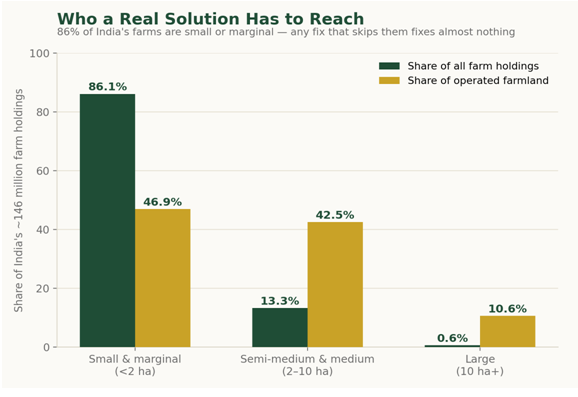
Figure 4: Share of India's farm holdings and farmland held by small/marginal, semi-medium/medium, and large farmers.
This changes what "scaling a solution" has to mean. A soil-health intervention that only reaches large, well-capitalized farms — even if it's perfectly executed — would touch barely 10% of India's farmland. To actually bend the national SOC and degradation curves, adoption has to reach deep into the small and marginal farmer base: tens of millions of individual growers, most operating under 2 hectares, most without easy access to soil testing, credit, or agronomic advisory.
Matched against the rebuild timeline above — a minimum 6-year runway just to see first measurable gains — the scaling clock and the biological clock are running at the same time. Realistically, this means:
- Reaching tens of millions of smallholders within this decade, not this generation — waiting a generation means compounding another 20-plus years of degradation on top of an already-declining base.
- Prioritizing the states and soil types already showing the sharpest signals — the acidic, Fe/Al-dominant, high-erosion regions identified in national data — rather than spreading resources evenly.
- Making interventions inexpensive and simple enough for a 1-hectare farmer to adopt without new equipment, new credit, or new land — since anything that requires capital intensity structurally excludes 86% of the farmer base.
Soil health in India isn't a problem that gets solved by a handful of demonstration farms, however excellent. It gets solved — or it doesn't — at the scale of tens of millions of small holdings, farmed by people who need solutions that are simple, affordable, and biological enough to work with the land they already have.
The Window Is Open, But It's Not Wide
None of this data points to a hopeless picture — SOC can be rebuilt, degraded land can be restored, and nutrient ratios can be corrected. But every one of those processes takes years, not seasons, and every year of delay adds to a deficit that the next intervention will have to work harder to close.
At Bio Prime, this is the scale we build for: biological solutions engineered to work in the soils India actually has — acidic, Fe/Al-locked, nutrient-imbalanced — and simple enough to reach the smallholders who farm most of this country's land. Rebuilding soil health isn't a slogan. It's a multi-year, tens-of-millions-of-farmers effort that has to start now, because the data says we're already mid-decline, not standing still.