
COUNT THE DAYS: A PRACTICAL GUIDE TO PRE-HARVEST INTERVALS
- BioPrime Stories & latest news

- COUNT THE DAYS: A PRACTICAL GUIDE TO PRE-HARVEST INTERVALS
COUNT THE DAYS: A PRACTICAL GUIDE TO PRE-HARVEST INTERVALS

The single most controllable variable in India's residue problem isn't the chemical you choose-it's the calendar you spray it on
The last piece in this series looked at why Indian shipments keep getting turned back at foreign ports-which chemicals, which crops, and why. This piece goes one layer deeper, into the one lever every farmer already controls without buying anything new: the gap between the last spray and the day the crop is picked.
That gap has a name — the pre-harvest interval, or PHI — and it turns out to be far more chemical-specific, crop-specific, and even climate-specific than most spray calendars assume. Get it right and a residue-flagged shipment becomes a routine one. Get it wrong, even while technically following the label, and the same chemical can clear a pepper crop cleanly while leaving a celery crop illegal for export.
What a PHI Actually Is
A pre-harvest interval is the minimum number of days that must pass between a pesticide application and harvest, and it is printed on the product label as a legal requirement, not a suggestion. As Mississippi State University's Extension Service puts it plainly: for some products the wait is “spray up to day of harvest”; for others it can run 21 days or considerably longer, and the interval is rarely the same for two different crops sprayed with the same product. During that window, sun, rain, temperature, and the plant's own metabolism break the chemical down — which is precisely why the interval cannot be treated as a fixed, universal number.
The mechanism is straightforward: a pesticide residue declines over time, typically following a predictable decay curve, until it drops below the Maximum Residue Limit (MRL) the destination market enforces. Harvest before that curve crosses the line, and the shipment carries a residue violation even if every other part of the application was done correctly.
The Same Chemical Can Behave Completely Differently, Crop to Crop
This is the part most spray calendars miss entirely. A rigorous 2013 study in Environmental Science & Technology systematically reviewed 811 published studies covering 4,513 measured pesticide dissipation half-lives across 346 pesticides and 183 plant species — and found the variability enormous, driven by leaf wax thickness, surface hairs, plant architecture, and whether the residue sits on the surface or has been absorbed into the tissue. A separate database effort feeding the Pesticide Properties Database (PPDB) at the University of Hertfordshire compiled dissipation data from 1,390 published articles across more than 400 pesticides and 200 crops, for exactly this reason: one number does not travel between crops.
A Chinese greenhouse study makes the point concretely. Six vegetables were sprayed with the same chlorpyrifos treatment and harvested at the same 21-day interval:
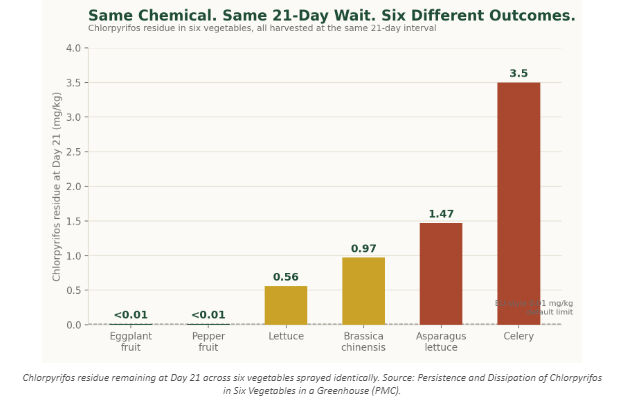
Eggplant and pepper fruit were both essentially clear by Day 21. Celery, at the same interval, still carried 3.50 mg/kg — 350 times above a 0.01 mg/kg default limit. The chemical was identical. The application was identical. The only variable was the crop's own surface structure and metabolism. A 21-day PHI that is genuinely safe for one vegetable can be dangerously insufficient for another grown in the very next row.
Why the Label PHI Isn't Always What the Chemistry Suggests
Here is a finding worth sitting with. A university study from Lebanon measured imidacloprid dissipation directly on grapes and vine leaves and found a half-life of just 0.5 days on both — so fast that the researchers concluded no pre-harvest interval was technically necessary on grapes at all based on the measured chemistry. And yet the standard US vineyard label for the same active ingredient (Admire Pro) carries a 21-day PHI — among the longest of any commonly used vineyard insecticide.
This isn't a contradiction; it's a reminder of what a label PHI is actually built for. Regulatory PHIs are set with deliberate safety margins to cover worst-case dose, formulation, weather, and measurement variability — not the average or best-case dissipation rate. A farmer who reasons “this chemical clears fast, so I can cut the interval short” is substituting their own guess for a figure regulators built in layers of caution. The label PHI is always the number to follow, precisely because it already assumes conditions won't be ideal.
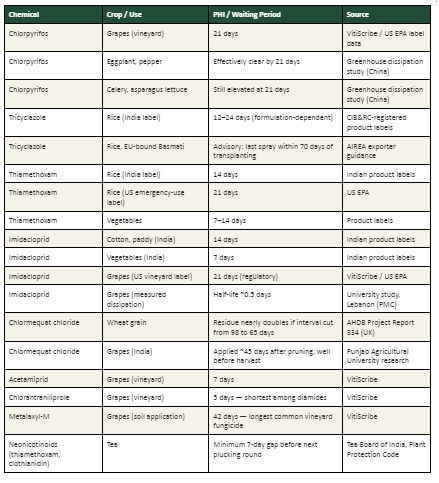
A Chemical-by-Chemical, Crop-by-Crop Reference
This is not exhaustive, and every figure should be checked against the current product label before use — formulations and registrations change. But it gives a working sense of how differently these intervals actually run:
The Vineyard Case Study: Building a Spray Ladder
Grapes are one of India's most residue-flagged export crops, and vineyard spray programs are a good illustration of how PHI-aware planning actually works in practice: not avoiding certain chemicals altogether, but sequencing them so the longest-PHI products are used earliest in the season and only short-PHI or zero-PHI options remain as harvest approaches.
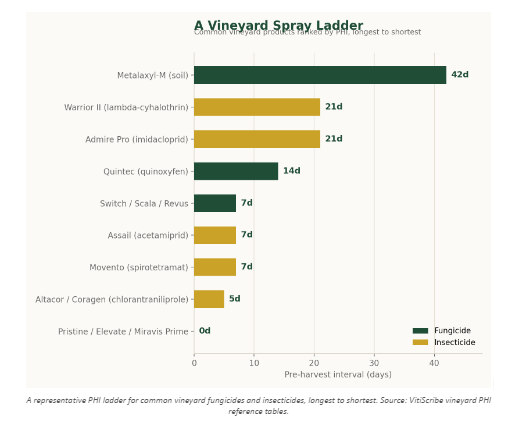
A soil-applied fungicide like metalaxyl-M, with a 42-day PHI, has to be finished well before bloom on an early-harvest block. Insecticides like imidacloprid or lambda-cyhalothrin, both around 21 days, need to be retired a full three weeks out. As harvest nears, only the 5–to-7-day products — or genuinely zero-PHI options — remain usable at all. Building a season's spray plan backward from the harvest date, rather than forward from whenever a pest is first noticed, is the entire discipline.
The Tricyclazole Problem: Why the Label PHI Isn't the Real Number for Export
India permits tricyclazole residues on rice up to 3 ppm; so does the US. Japan allows up to 10 ppm. The EU's limit is 0.01 ppm — roughly 300 times stricter than India's own domestic standard. A 12–24 day label PHI, entirely sufficient for the Indian or US market, does not reliably clear a crop down to that EU threshold.
This is why exporter associations have pushed a different, more conservative rule of thumb: apply tricyclazole only within the first 70 days after transplanting, on a crop that typically takes 120–150 days to mature. That builds in 50 or more additional days of natural degradation beyond the standard label PHI — a buffer large enough to plausibly reach the EU's far lower limit, though even that guidance remains imperfect once weather, dose, and application timing vary field to field. When the EU cut its tricyclazole tolerance from 1 ppm to 0.01 ppm, Indian Basmati exporters are estimated to have lost over $200 million in revenue in under two years, according to industry analysis — a direct, measurable cost of a PHI gap nobody had planned for because the destination market's rules changed faster than farm practice did.
Tea's Different Problem: There Is No Single Harvest Day
Every crop discussed so far has one harvest date to plan backward from. Tea doesn't — it's plucked continuously, every 7 to 10 days, for most of the year. The Tea Board of India's Plant Protection Code addresses this directly: pesticide can be applied only immediately after a plucking round, subject to a minimum 7-day gap before the next one, with some products like clothianidin restricted to fortnightly (14-day) intervals. The “PHI” for tea isn't a single countdown to one harvest — it's a rolling constraint that has to be re-satisfied before every single plucking round, all season long, which is a meaningfully harder discipline to maintain than a one-time interval on a seasonal crop.
Where This Points, Practically
None of this argues for spraying less than a crop needs. It argues for planning the calendar with as much rigor as the dose. Two practical shifts follow directly from the data above:
-
Sequence products by PHI, not by convenience. Save the longest-PHI, most persistent chemistries for early-season use, and reserve short-PHI or biological options for the final weeks before harvest, when the countdown clock actually matters most.
-
For ultra-low-MRL destinations, don't trust the label PHI alone. Where a 0.01 ppm limit applies, build in a buffer well beyond the standard label interval — as India's own rice exporters have had to learn the expensive way.
This is exactly the window biological products are best suited to fill — the last spray cycle before harvest, where a fast-degrading, low-residue option removes PHI risk almost entirely rather than requiring a farmer to calculate it precisely. As covered in the earlier piece in this series, that isn't a case against chemistry; it's a case for using each tool in the part of the season it's actually built for.
Sources & Further Reading
-
Wolters, A. et al. (2013) — Variability of Pesticide Dissipation Half-Lives in Plants. Environmental Science & Technology (ACS) — https://pubs.acs.org/doi/10.1021/es303525x
-
Development of a Data Set of Pesticide Dissipation Rates in/on Various Plant Matrices for the PPDB (Data journal / University of Hertfordshire) — https://doi.org/10.3390/data2030028
-
Persistence and Dissipation of Chlorpyrifos in Six Vegetables in a Greenhouse (PMC) — https://www.ncbi.nlm.nih.gov/pmc/articles/PMC4072623/
-
The Effects of Formulation on Imidacloprid Dissipation in Grapes and Vine Leaves — Lebanese climatic conditions (PMC) — https://www.ncbi.nlm.nih.gov/pmc/articles/PMC8746927/
-
VitiScribe — PHI for Common Vineyard Insecticides: Quick Reference — https://vitiscribe.com/phi-insecticides-vineyard-common-products/
-
VitiScribe — PHI for Common Vineyard Fungicides: Quick Reference — https://vitiscribe.com/phi-fungicides-vineyard-common-products/
-
AHDB — Project Report No. 334: Effects of Timing and Dose on Residues of Chlormequat — https://projectblue.blob.core.windows.net/media/Default/Research%20Papers/Cereals%20and%20Oilseed/pr334-final-project-report.pdf
-
Tea Board of India — Plant Protection Code (Version 16, February 2024) — https://teaboard.gov.in/pdf/PPC_ver_16_February_2024_pdf7663.pdf
-
Eurofins / Cereal Technology — Pesticide Residue Legislation Challenges to International Trade (tricyclazole MRL impact) — https://cdnmedia.eurofins.com/eurofins-germany/media/2856063/2002_pesticide-residue-legislations_cereal-technology.pdf
-
Krishi Jagran — Tricyclazole Levels Permitted in India is 3 ppm for Basmati Rice — https://krishijagran.com/news/tricyclazole-levels-permitted-in-india-is-3-ppm-for-basmati-rice/
-
The Tribune — Panicked Basmati Exporters Hold Crash Course for Farmers — https://www.tribuneindia.com/news/archive/business/panicked-basmati-exporters-hold-crash-course-for-farmers-669637
-
National Pesticide Information Center — Preharvest Interval (PHI) — http://www.npic.orst.edu/health/phi.html
-
Mississippi State University Extension — Preharvest Interval (PHI) — https://www.extension.msstate.edu/newsletters/bugs-eye-view/2024/preharvest-interval-phi-vol-10-09
-
Punjab Agricultural University (via Springer, Applied Fruit Science) — Effect of Chlormequat Chloride on Grape Cultivars Under Protected Cultivation — https://link.springer.com/content/pdf/10.1007/s10341-022-00781-9.pdf
Note: PHI and MRL values are drawn from the sources above, which reflect specific formulations, geographies, and years cited; product labels are revised periodically and regulatory tolerances (especially in the EU) change without much notice. Always confirm current PHI against the specific product label and destination-market MRL before planning a spray program — this piece is intended as a working reference, not a substitute for the label.